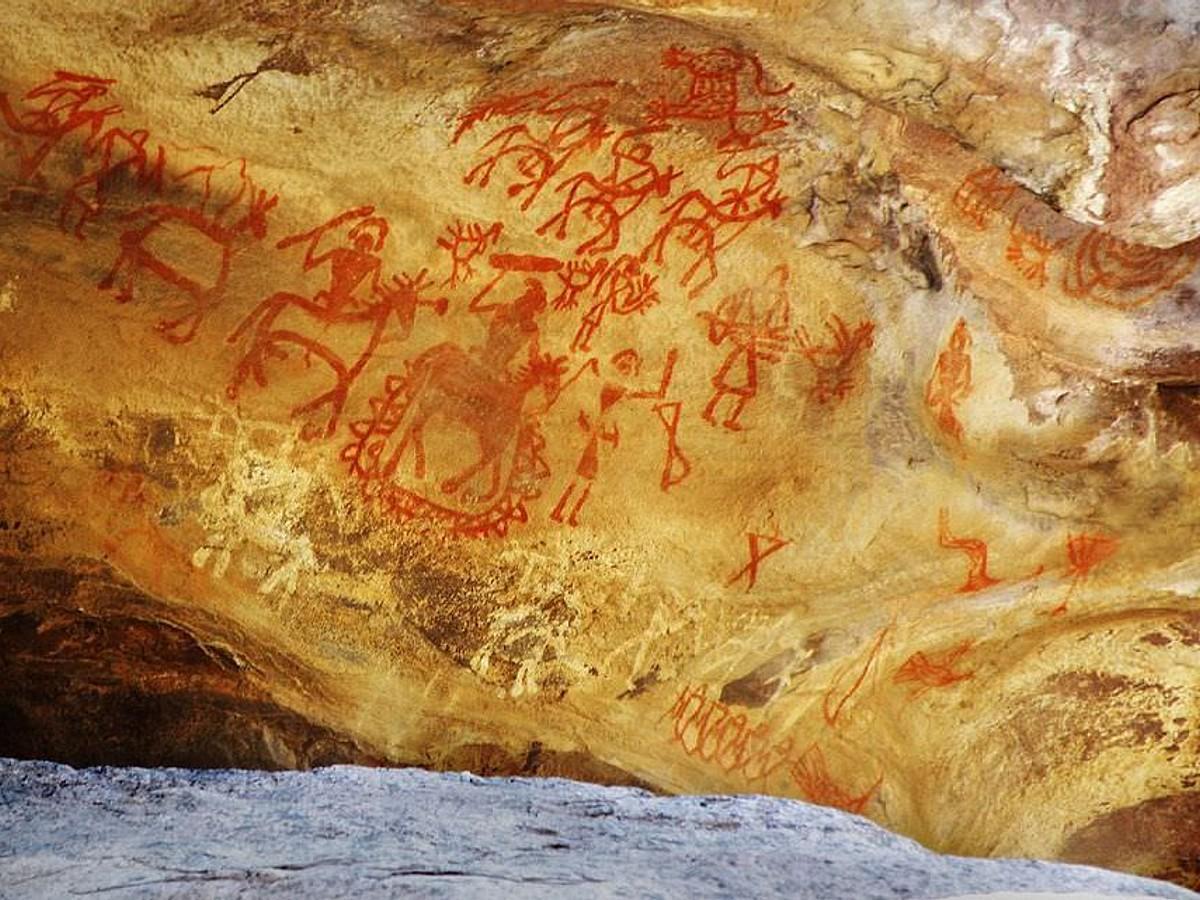
Before History: From Bhimbetka to Mehrgarh
Long before cities, kingdoms or writing, people in the Indian subcontinent were making tools, painting rock walls and learning to farm. This is where the story of Bharat begins.
parimiti03@gmail.com
Series: History of Bharat, from the beginning to today · Part 01 · Era: Prehistory to c. 3300 BCE
In one line: Long before cities, kingdoms or writing, people in the Indian subcontinent were making tools, painting rock walls and learning to farm. This is where the story of Bharat begins.
The first footprints
The story of Bharat does not begin with a king or a book. It begins with stones shaped by human hands. At Attirampakkam, near Chennai in Tamil Nadu, archaeologists have found hand-axes and cleavers of the Acheulian tradition that scientific dating places at no less than 1.07 million years, and possibly about 1.5 million years old [6]. These were made by early human species, not by modern humans like us, but they show that the subcontinent was part of humanity's story from very early on.
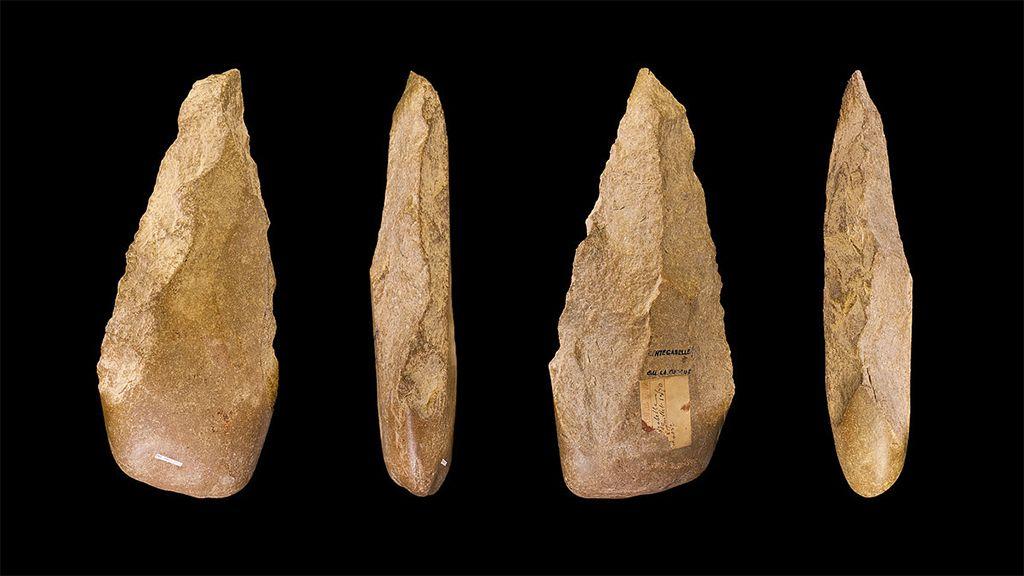
Acheulian hand-axes look like this. These examples are from Cintegabelle, France, not from Attirampakkam. Photo: Didier Descouens / Muséum de Toulouse, CC BY-SA 4.0, via Wikimedia Commons.
The same site later showed something more surprising. A 2018 study found more refined, "Middle Palaeolithic" tools there dating back about 385,000 years, which suggests that tool-making ideas were developing in India far earlier than many had assumed [7].
Bhimbetka: the walls that remember
In the foothills of the Vindhya hills in Madhya Pradesh, about 45 km from Bhopal, lie the rock shelters of Bhimbetka. The archaeologist V. S. Wakankar recognised their importance in 1957–58. Today more than 750 shelters are known, and some of them were lived in for over 100,000 years [1][4][5].
What makes Bhimbetka unforgettable is its art. On the sandstone walls, people painted animals, hunts, dances and group scenes in red and white. The oldest paintings are generally placed in the Mesolithic (Middle Stone Age); later layers continue into historical times. UNESCO inscribed the Rock Shelters of Bhimbetka as a World Heritage Site in 2003, noting the unusually long continuity between the paintings and the culture of the villages around them today [1][2][3].
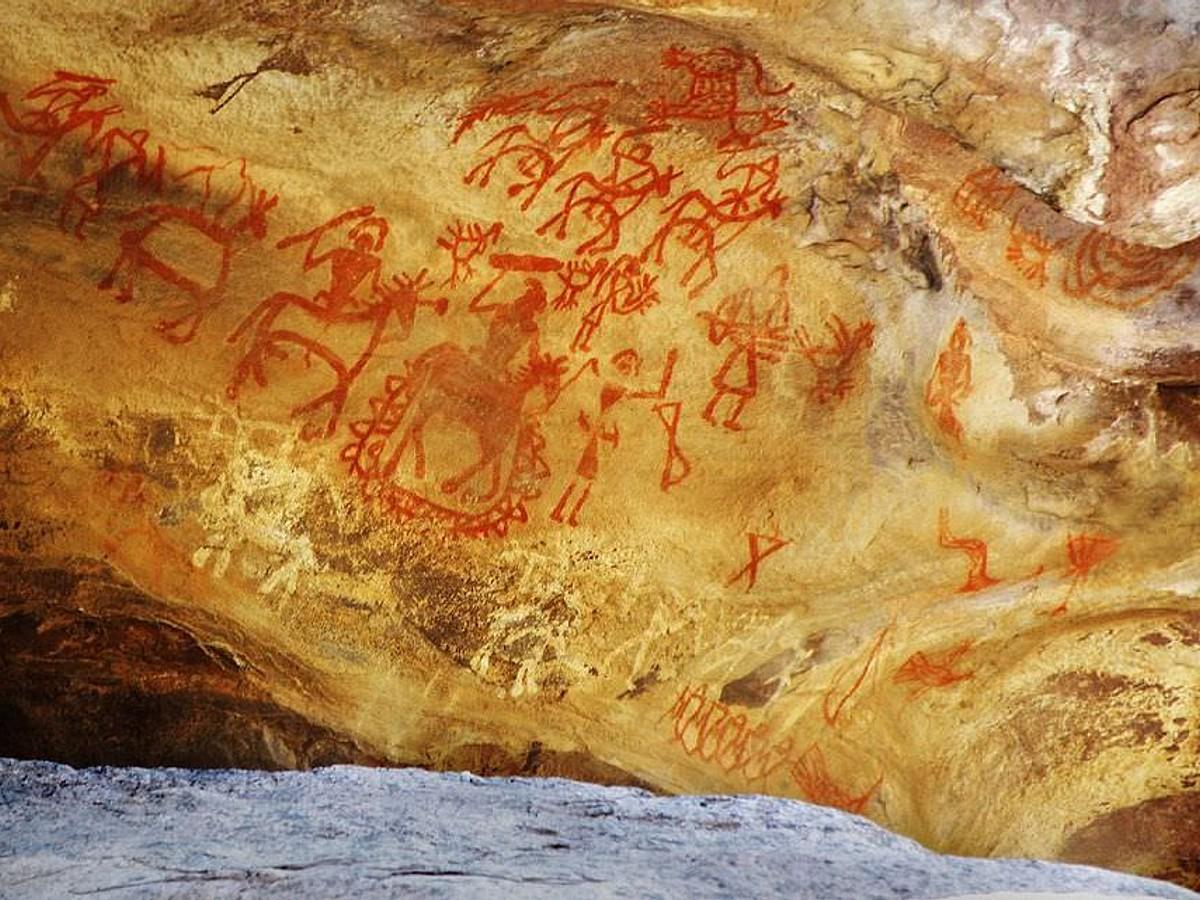
Rock paintings at Bhimbetka, Madhya Pradesh. Photo: Raveesh Vyas, via World History Encyclopedia, CC BY-NC-SA 4.0.
The name comes from local tradition linking the site to Bhima of the Mahabharata. That is a living story, not an archaeological finding, and it shows how places in India carry many layers of memory at once.
Smaller tools, bigger changes
After the last Ice Age ended, about 12,000 years ago, the climate became warmer. People in the subcontinent began making microliths, tiny sharp stone blades fitted into wooden or bone handles to make arrows, sickles and spears. Sites such as Bagor in Rajasthan and Adamgarh in Madhya Pradesh show communities that hunted and fished but also began to keep animals [10].
This period is called the Mesolithic, and it is the bridge between wandering hunters and settled farmers.
Mehrgarh: learning to farm
One of the most important early farming villages in South Asia is Mehrgarh, at the foot of the Bolan Pass in Balochistan (today in Pakistan). French archaeologists Jean-François Jarrige and Catherine Jarrige began excavating it in 1974. They dated its earliest farming levels to around 7000 BCE, and most textbooks still give that date [10].
In 2025, a new study radiocarbon-dated tooth enamel from 23 burials in those early levels. It suggests that farming life at Mehrgarh began much later, around 5200–4900 BCE [9]. Scholars are still debating the two timelines. Either way, Mehrgarh is one of the oldest known farming villages in South Asia.
At Mehrgarh, people grew barley and wheat, kept cattle, sheep and goats, lived in mud-brick houses, and buried their dead with beads and ornaments. Some people's molars were drilled with tiny flint tips, the oldest known evidence of drilling living human teeth [8]. Mehrgarh shows how village farming took root in this region and grew, step by step, into the life that later fed the Harappan cities.
Many paths to settled life
Farming did not begin in one place and spread in one line. Across the subcontinent, communities took different paths [10]:
Burzahom in Kashmir had people living in pit-houses dug into the ground.
In the Ganga plains, sites such as Lahuradewa and Koldihwa in Uttar Pradesh show early rice use.
In the Deccan and South India, Neolithic herders left large "ash mounds" from burning cattle dung, at sites such as Budihal and Sanganakallu in Karnataka.
Later, in the Chalcolithic (copper–stone) age, communities in Rajasthan, Malwa and Maharashtra began using copper alongside stone, painting fine pottery and building larger villages.
Why this matters today
Prehistory can feel distant, but it is the foundation of everything that followed. The crops first grown in these villages, the habit of keeping cattle, the painted walls and the local knowledge of land and seasons became part of the deep inheritance of Bharat. The adivasi villages near Bhimbetka, whose art and life echo the old paintings, remind us that this past is not entirely past.
A question to carry forward: if people were painting the walls of Bhimbetka thousands of years before any written record, how much of Bharat's story is still waiting in the ground?
Key dates
c. 1.07–1.5 million years ago: Acheulian tools made at Attirampakkam, Tamil Nadu
c. 385,000 years ago: Middle Palaeolithic tools at Attirampakkam
Over 100,000 years ago: Some Bhimbetka shelters already inhabited
c. 10,000 BCE onward: Mesolithic microlith cultures; early Bhimbetka paintings
c. 7000 BCE (older dating) or c. 5200 BCE (2025 dating): Earliest farming levels at Mehrgarh
1957–58: V. S. Wakankar identifies Bhimbetka's importance
2003: Bhimbetka inscribed as a UNESCO World Heritage Site
Sources
UNESCO World Heritage Centre, Rock Shelters of Bhimbetka (No. 925), Decision 27 COM 8C.21 (2003)
UNESCO, Bhimbetka nomination file, inscribed 5 July 2003
Press Information Bureau, Govt of India, Bhimbetka declared World Heritage, July 2003
Ek Bharat Shreshtha Bharat, Govt of India, Bhimbetka (discovery by V. S. Wakankar, 1957–58)
Encyclopaedia Britannica, Bhimbetka rock shelters
Pappu, S. et al. (2011), "Early Pleistocene presence of Acheulian hominins in South India", Science 331: 1596–1599
Akhilesh, K. et al. (2018), "Early Middle Palaeolithic culture in India around 385–172 ka", Nature 554: 97–101
Coppa, A. et al. (2006), "Early Neolithic tradition of dentistry", Nature 440: 755–756
Mutin, B. et al. (2025), "New radiocarbon dates of human tooth enamel reveal a late appearance of farming life in the Indus Valley", Scientific Reports 15: 11345
NCERT, Themes in Indian History, Part I (Class 12) and Our Pasts I (Class 6), for the Mesolithic and Neolithic overview
Related Articles
इतिहास से पहले: भीमबेटका से मेहरगढ़ तक
शहरों, राज्यों और लिपि से बहुत पहले, इस उपमहाद्वीप के लोग औज़ार बना रहे थे, चट्टानों पर चित्र उकेर रहे थे और खेती करना सीख रहे थे। भारत की कहानी यहीं से शुरू होती है।

Forts of Rajasthan — Tales of Valor and Glory
Jaipur, Jodhpur, Udaipur — the magnificent forts of Rajasthan and their incredible stories.

Digital India — How Technology is Transforming the Nation
UPI, Aadhaar, and the startup ecosystem — how technology is reshaping India's future.